
Alternative transportation provides research possibilities

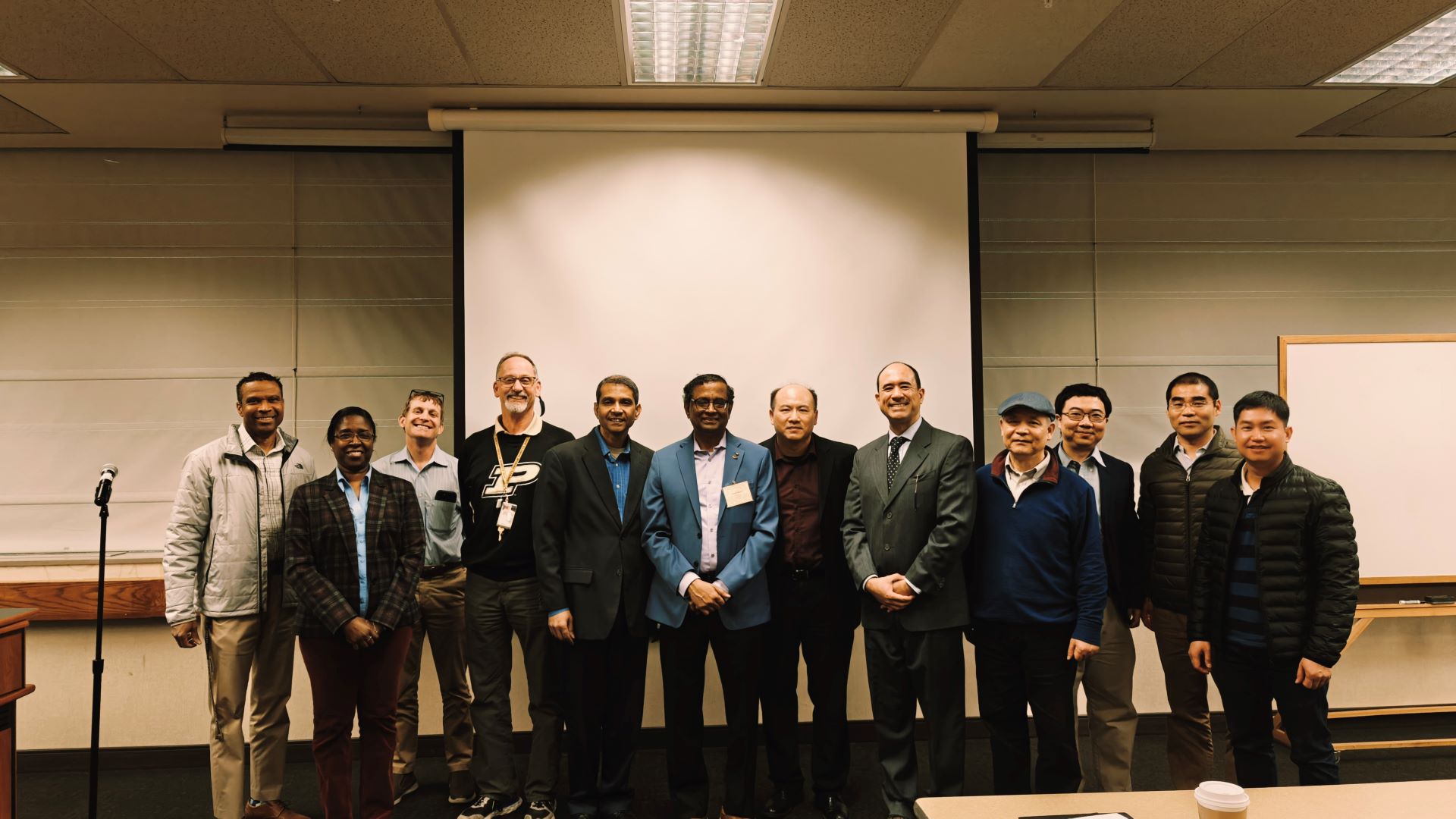
Henry Zhang, assistant professor of mechanical engineering technology, and graduate students James Walls, Qiong Li show off their scooter, while graduate students Philip Duros and Sandun Kuruppu join Athula Kulatunga, associate professor of electrical engineering technology, in demonstrating their electric tricycle.

Henry Zhang, assistant professor of mechanical engineering technology, and graduate students James Walls, Qiong Li show off their scooter, while graduate students Philip Duros and Sandun Kuruppu join Athula Kulatunga, associate professor of electrical engineering technology, in demonstrating their electric tricycle.

Two College of Technology professors and their students have created alternative modes of transportation as part of their research. The final products, however, are not for mass production. They are teaching tools made possible by industry grants as well as faculty and student research.

Henry Zhang, assistant professor of mechanical engineering technology, has been using mechatronics to create what has become known as the “tai chi scooter”.

Athula Kulatunga, associate professor of electrical engineering technology, has been focused on an electrically powered, energy-testing machine in the form of a recumbent bicycle, also called the “electric tricycle”.

Tai Chi Scooter

The creation of the hands-free, Tai Chi scooter has allowed students to follow a project from concept to design to construction.

Zhang, three graduate students, and one undergraduate student spent several months designing and building the two-wheeled, self-balancing scooter that moves based on the principles of Tai Chi, a form of Chinese martial arts that centers on focusing the mind and staying aware of your center of balance.

Initial funding

Ford Motor Company

Impacts

  • Student programmer became an expert in LabView software
  • Students exposed to cutting-edge design concepts
  • Built in Purdue's Multidisciplinary Design Lab
  • Will lead to creation of more mechatronics-based courses

The scooter has multiple functions and safety features with a real-time controller, latching relay system, drives and motors. Multiple sensor fusion perceives the movement of the rider and feeds the signals to the controller to slow down or accelerate the machine accordingly.

“If they can handle this complicated device, they can design almost all industry-required smart machines/products,” Zhang said. “It prepares engineers and work forces with knowledge required for the 21st century.”

The scooter project is the first step in creating what Zhang calls a “hands-on, minds-on, multidisciplinary mechatronics curriculum” to train students and engineers from industry.


Electric tricycle

Six students have assisted Kulatunga in the development of the energy-efficient recumbent bicycle. All students learning power electronics in energy systems have also been involved in testing and data collection. Many visitors, including guests from Germany and Peru, have driven the quiet ride, which can go as fast as 30 mph.

Initial funding

General Motors Company

Impacts

  • Students use as a learning platform for power electronics and applied research on controllers, charging devices, battery configurations and motor drives
  • Built in Purdue's International Rectifier Power Electronics Development and Application Lab (IR-PEDAL)

It is powered by electric charge and can be ridden on its own or connected to a data-collection test stand, where researchers can analyze power usage and efficiency.

The research team first built the bike as a standard tricycle. But after initial tests, the team redesigned the vehicle to give it more stability and better handling.

"We decided on a tricycle because it is a fun design that also happens to be ideal for performing analysis on power usage," Kulatunga said.

He said further modifications to the tricycle will be made periodically as he and his students conduct further research. They have also built the test stand for the vehicle, which makes in-house testing possible.

The tricycle is powered by a brushless DC motor attached to the back wheels, along with lead-acid batteries, which are located underneath the bike. He said attaching the motor to the wheel is more efficient because it provides a direct transfer of power, preventing much of the energy loss that would take place if the motor were placed in the middle of the vehicle. To improve the energy efficiency of the vehicle, it is equipped with ultracapacitors, which help to capture energy that would typically be lost during such actions as braking.

"This teaches students to think out of the box and apply what they are learning in the classroom to the real world," said Kulatunga, who was named to Purdue's Kauffman Campuses Initiative Entrepreneurial Leadership Academy. "When students work on projects like this, they begin to open their minds to new ideas and innovations, and even the possibilities of entrepreneurship and one day launching a business from their inventions."

The tricycle was built in Purdue's International Rectifier Power Electronics Development and Application Lab, known as IR-PEDAL, which focuses on energy-efficiency-related applied research in three main areas: motion controls, power conversions and audio amplifiers.