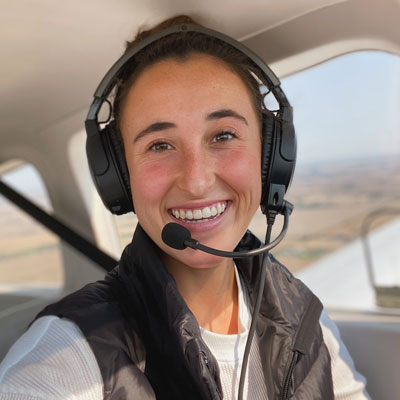
Gain a larger perspective of the aviation industry, from making decisions to understanding your aircraft, as you train to become a pilot.
Professional Flight Major
A major in the Professional Flight Program
in the School of Aviation and Transportation Technology
More than a flight school, Purdue offers a bachelor’s degree in professional flight that provides you with a larger perspective of the aviation industry. Your classes range from how an airplane is built to decision-making in the airline industry. You will learn by flying in our state-of-the-art fleet and matching simulators, and from aviation professionals with significant industry experience.
The School of Aviation and Transportation Technology encourages you to obtain the highest level of medical and student certificates possible during your time at Purdue.
Special Features
- Earn private and commercial pilot certificates and an instrument rating
- Elite R-ATP flight school - graduates qualify with only 1,000 flight hours
- Work toward certification to become a flight instructor and help teach younger students to fly
- Complete and extend your flight training in state-of-the-art airplanes.
- Two degrees in five years: earn your bachelor’s degree in flight and master’s degree in aviation and aerospace management in only five years with a special plan of study.
- Get involved with various student organizations specifically for aviation students
- Utilize the Polytechnic learning environment to become a career-ready graduate
Additional fees for flight courses can be found here.
Fees will be assessed for no-shows. The current policy can be found here.
Certain first-year professional flight students may qualify for the Degree in 3 program. Learn more here.
Current Students: Flight Operations Information
Program Educational Goals (PEGs)—Professional Flight Technology
The educational goal of the B.S. in Professional Flight Technology program is to progressively develop proficiency in the following six competencies. At least 80% of the students will be able to demonstrate their knowledge, skills, and abilities in each of these competencies by scoring 80% or better at the proficient level.
- Leadership
- Technical Excellence
- Decision-Making
- Communication
- Teamwork
- Resilience
Three levels of performance were identified for each competency: emerging (level 1), developing (level 2), and proficient (level 3).