purdue university home page

Purdue University

College of Technology

Electrical and Computer Engineering Technology

About Us

about us

About EET Graduates:

The Electrical Engineering Technology (EET) program is an engaging, rigorous, experiential approach to preparing professionals to be successful in the field of electronics engineering as practitioners.  Graduates are fully prepared to accept and succeed in a wide variety of professional positions in companies which include electronic devices in their products or in the manufacture of their products.  Employers range from those in Indiana to others around the United States and the world.

Sections below show typical starting salaries and placement information for EET graduates, their career titles, and typical employers.  Since many of the graduates are placed into starting positions with the title of ‘engineer’, the last section contains a brief comparison of the EET program and typical engineering degree program characteristics.


Starting Salaries and Placement rates for EET Graduates:

The graph below shows the starting average salaries for EET graduates over the last 10 years ('CpET' shows the average starting slaries for graduates in the CpET specialization):

ECET Placement

Placement rates have exceeded 90% every year for the past 10 years.


Starting Career titles for the EET graduating class of 2006:

These titles are the actual titles of the positions filled by EET graduates from the class of 2006.  There are many more positions available to EET graduates in addition to those of this particular graduating class:

Affiliate Engineer
Applications Engineer (2)
Automotive Design Engineer
Beta Support Engineer
Controls Engineer
Customer Quality Engineer
Design Engineer (6)
Electrical Engineer (3)
Electrical Manager
Electrical Support Engineer
Electronics Engineer
Embedded Software Engineer
Engineer (6)
Facilities Engineer
Field Engineer (2)
Generation Dispatch Engineer (2)
High Horsepower Service Engineer
Instrumentation/Controls Engineer
Instrumentation Technician
Market Research Analysis
Microprocessor Design Engineer
Network Integration Engineer
Operations Consultant
P&C Technologist (2)
Power R&D Engineer
Process Coordinator
Product Test Engineer
Project Engineer (2)
Project Manager
Sales Associate
Sensor Engineer (2)
Software Engineer (4)
Solutions Delivery Consultant
Staff Engineer (2)
Systems Engineer (2)
Systems Programmer
Technical Specialist
Technical Team Leader
Test Engineer (3)


Typical EET Graduate Employers

The employers listed below are a representative sample of employers from within Indiana and from other places who routinely hire EET graduates. There are many more employers who have and do hire EET graduates than show here.

Advanced Micro Devices (2)
American Electric Power (2)
Applied Instruments
BAE Systems (2)
Butler International (3)
B&W TEK
Cerner Corporation
Clark County REMC
Cornerstone Controls
Crown ESA
CTL Group
CTS
Cummins Engine Corporation (3)
Dekko Technical Center
Digital Home Lifestyles
Donahue & Associates
Echostar Satelite
Emerson Appliance Control
eServ LLC
Fiore Industries
Gallatin Steel
General Electric
Gentex
Headsight, Inc.
Hoosier Energy Co. (2)
Integrator.com
Intel
John Deere (2)
Keyence
Koontz-Wagner
Lattice Semiconductor
Light Machines
Malcolm Pirnie
Midwest ISO
Motorola
NASIC
NIPSCO
Nortel (3)
Northrop Grumman
NOVA Research
Priio (2)
QSC Audio
Raytheon
Rockwell Automation
Spraying Systems
Test & Controls International
Texture LLC
Thomas & Skinner
Underwriter Laboratories (2)
US Steel
Verizon
Wes-Tech, Inc.


What makes EET unique from an engineering degree program?

It is apparent that many of the EET graduates are employed as ‘engineers’ of one sort or another.  What is not so apparent are the differences (and similarities) in the EET and engineering degree programs and the nature of the successful EET graduates.  Some reference to the history of the programs (at least as they have evolved at Purdue University) is required to fully appreciate the current programs.

During the 1950’s and 1960’s the ‘space race’ and similar efforts to be technologically first internationally, caused engineering programs to center on creating graduates who were targeted at making new discoveries for the benefit of mankind and the progress of technology.  As a consequence, the engineering programs became more and more conceptually (theoretically) based, or a shift toward engineering science.  That is, they relied primarily on a mathematical basis to teach and to learn.  After all, if the graduate is expecting to discover that which does not exist, he or she cannot very well work with it as a part of their education.  The conceptual basis as the learning methodology continues today.

Only a portion of the engineering positions need conceptually based engineers.  As industry continues to progress, more and more engineers are needed with hands-on abilities to create electronic products and industrial control systems based on electronic systems. This type of engineer is often referred to as an “engineer practitioner.”

The College of Technology (CoT) was established in 1964 to fulfill this need by providing engineering practitioners.   One of the founding precepts of the CoT is that students learn to put concepts into practice. And so the College of Technology and the EET program were born.

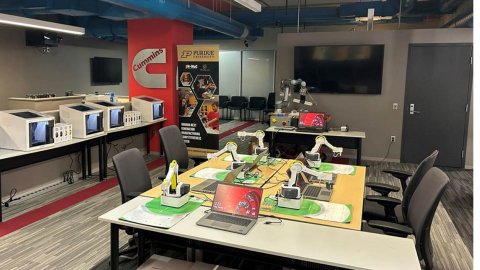
Students in the EET program learn engineering principles on an experiential basis.  The courses are lecture/laboratory based with each course including a laboratory component. The application-based, hands-on approach in the laboratory component is what separates the Purdue EET program from a Purdue engineering program.

The learning scenario in EET is as follows:

1. Students attend class lectures that are applications oriented.  That is the students learn the engineering principles from the perspective of studying the applications of the principles.

2. Students then attend a laboratory in which they apply the principles to electronic circuits through both simulation studies (as in the work place setting) and through hands-on experience with the electronic devices and systems. 

3. As their education progresses, students synthesize the knowledge and principles into working electronic systems that are very similar to those they will create during their careers.

The overall result of this approach is that the graduates are uniquely positioned to be beneficial to a wide range of employers.  And, best of all, they are ready to be productive when they ‘walk in the door’.

In summary, EET graduates learn in an applications-based, hands-on approach that allows them to build the knowledge and skills that are needed by employers and, hence, are in high demand upon graduation.